

01Fact Check
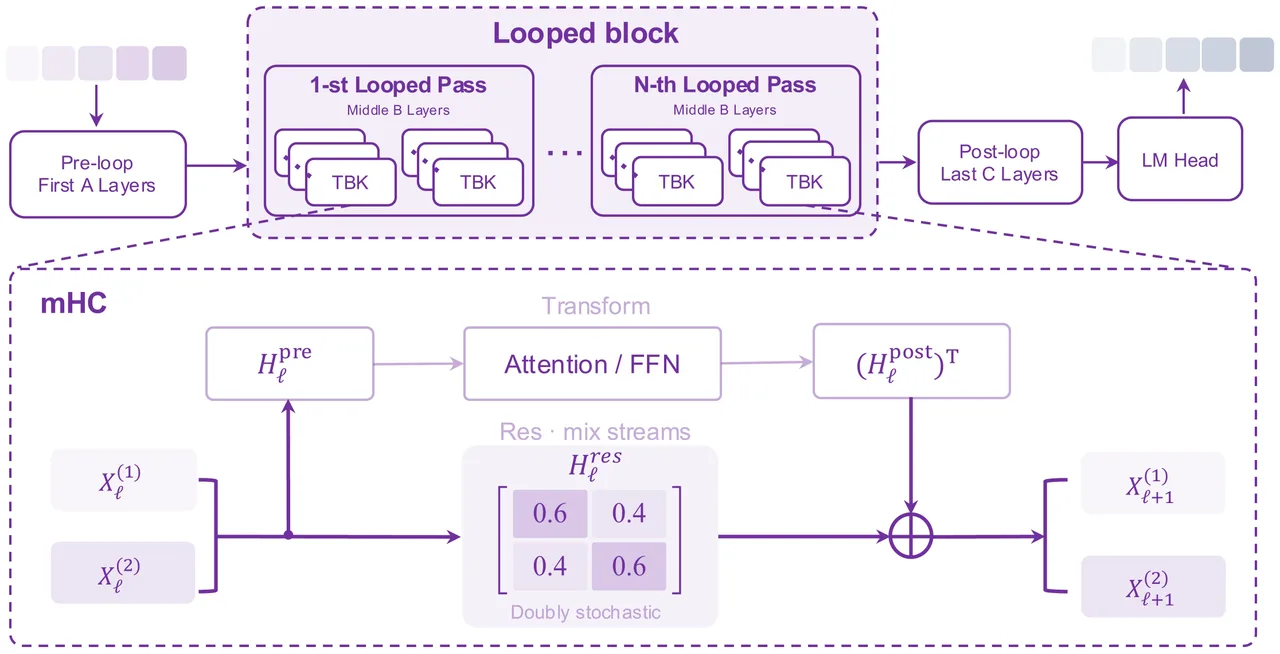
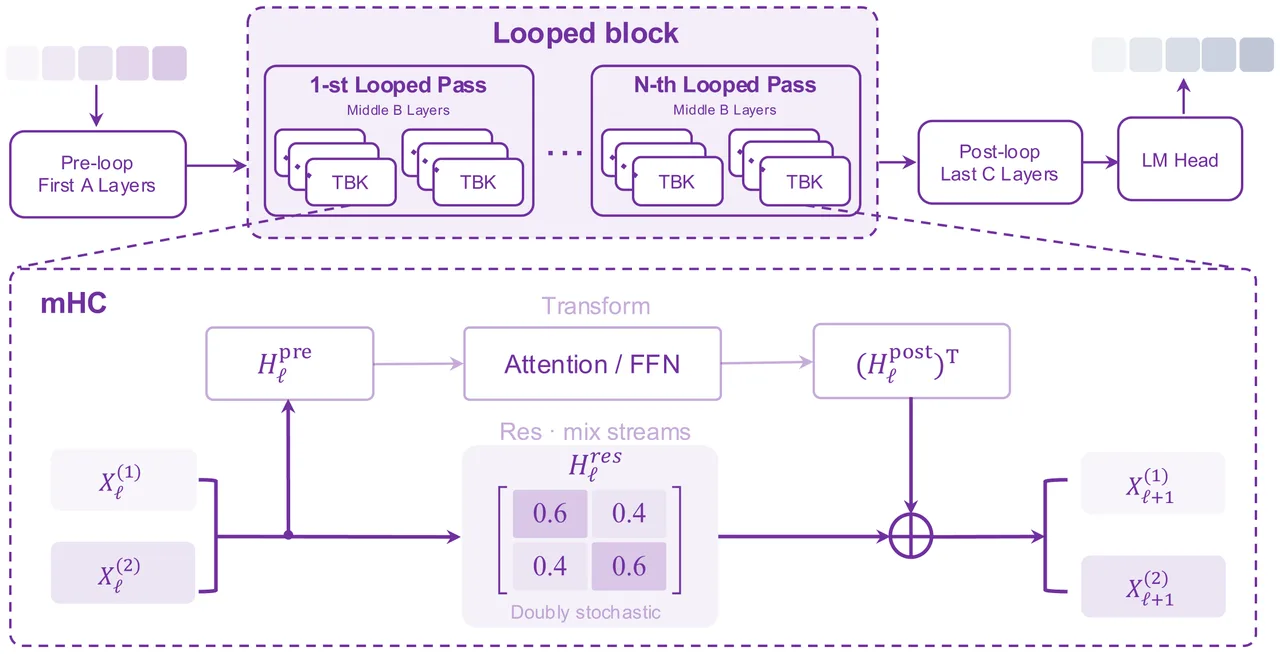
SenseTime's official X account announced on Beijing time 10 30 the open-source release of SenseNova Loop-9B-Preview: a multimodal model with a Looped Transformer architecture of roughly 9B parameters, with weights on Hugging Face and code on GitHub under the Apache 2.0 license. The core design is that 32 layers of weights are shared and looped to perform 56 layers of computation per forward pass: input passes through layers 0–3, layers 4–27 share weights and execute consecutively twice, and finally layers 28–31 produce the output — written as B(B(h)) in the model card.
Other specifications: hidden dimension 4,096, feed-forward dimension 12,288, vocabulary 248,320, 16 full attention heads and 4 KV heads; input is text and images, output is text; training context up to 262,144 tokens; weights exported in BF16, with mHC routing parameters at FP32. Attention uses a hybrid structure in groups of every 4 layers (3 linear attention layers + 1 full attention layers), with loop boundaries aligned to complete 4-layer groups.
02Self-Reported Benchmarks and Comparison Controversy
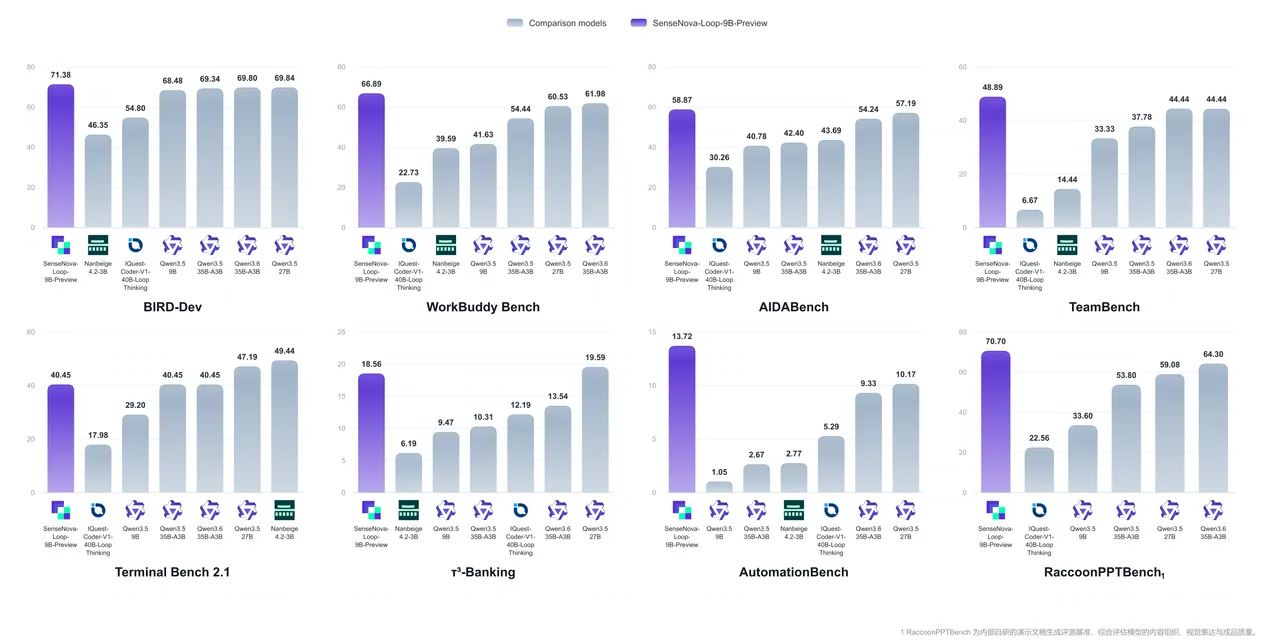
Officially, the model claims 27B-level performance, surpassing Qwen3.5-27B on benchmarks such as WorkBuddy Bench, RaccoonPPT Bench, and AutomationBench; of the 8 benchmarks in the attached figures, it leads on 6 and trails on 2 (Terminal Bench 2.1 at 40.45 versus Qwen3.5-27B's 47.19; τ³-Banking at 18.56 versus 19.59). The comparison lineup was chosen by SenseTime itself. The mHC component improved GPQA Diamond by 4.42 points and TeamBench by 13.34 points. The community questioned that the comparison did not include the newer Qwen3.8, and noted the absence of an ablation comparing the looped 9B against a standard 9B at equal compute.
03Deployment and Cost Accounting
Running the model requires Transformers 5.18.0 with PyTorch 2.11.0/CUDA 13.0, loaded with trust_remote_code; official deployment paths are a LightLLM four-GPU container example or the SGLang PR #47281 branch. Community estimates: the KV cache is stored per pass, with the 6 full attention layers inside the looped segment equivalent to 14 layers of KV; at BF16, roughly 57 KB per token, and about 15 GB at 262K context (versus roughly 8.6 GB without looping). The technical report is marked TBD, and an official Transformers-compatible implementation is yet to be released; MTP acceleration is already available, while Dspark and Dflash2 are still training.
Editorial Analysis Inferred from source information
The looped architecture trades FLOPs and latency for storage and a deeper computation path, suiting storage-constrained scenarios that can tolerate higher per-token compute costs. The "27B-level performance" claim still awaits independent testing and tokens/second comparisons, and given that 2 of the 8 benchmarks already trail, it should be treated as a technical validation rather than a selection conclusion to replace 27B models.