

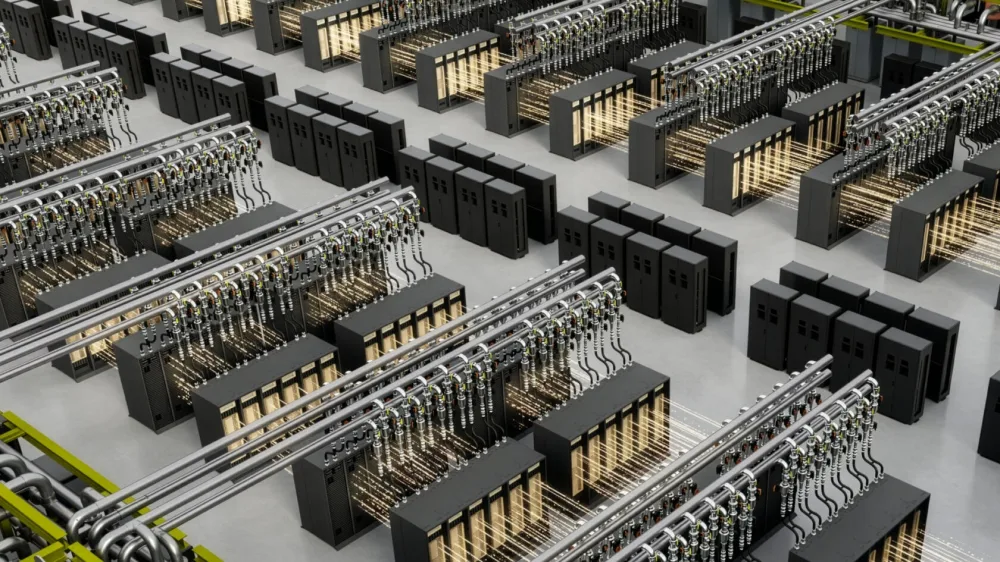
Key facts: At the OCP Global Summit opening in San Jose, NVIDIA announced that it will contribute the key rack and compute tray designs of its next-generation Vera Rubin platform to the Open Compute Project (OCP) via the MGX architecture, giving system vendors a unified blueprint for planning AI data center racks, networking, power, and cooling.
Technical highlights: The updated MGX 1.2 specification introduces rack-level blind-mate liquid cooling—when a compute tray is pushed into the rack, the liquid cooling connectors mate automatically, eliminating the need to hook up lines one by one by hand; it offers a 5000-amp liquid-cooled busbar for higher-power systems; rack deployment capability of up to 250 kilowatts; native support for 19-inch devices; plus configurable I/O pods, fanless liquid-cooled compute trays, and standardized power and cooling interfaces. NVIDIA says these improvements significantly shorten assembly, testing, and field maintenance time.
Platform extension: NVIDIA also announced the Vera CPU rack design specification. Unlike the Vera Rubin NVL72, which handles large-scale training and inference, the Vera CPU rack is specifically designed for the computing infrastructure needed for the day-to-day operation of agentic AI, such as tool calling, task orchestration, and sandbox execution. On the software side, the DSX AI factory platform adds new open-source components including switch auto-configuration, GPU cluster stress testing, and rack management, claiming it can compress the time to turn bare metal into a production cluster from days to hours.
Open standards: NVIDIA, together with AMD, Google, and Meta, released the Open Data Center Specification v0.7, unifying the power architecture, cooling infrastructure, and physical layout of next-generation AI factories; and with Google, Meta, and Microsoft, it released a Power Grid Resilience Specification requiring large AI facilities to stay connected during grid disturbances, respond automatically, and return to near-full load operation within two seconds.
Networking ecosystem: Meta announced it will adopt NVIDIA's Spectrum-6 102.4T Ethernet switches, with its in-house N-IceCube switches running the open-source FBOSS network operating system, combined with Multiplane technology to support an agentic AI factory with more than 100,000 GPUs; Google's Falcon transport protocol will in the future come to NVIDIA's ConnectX-10 SuperNIC and BlueField DPU, enabling the two types of network cards to interoperate via a common transport layer. Hon Hai's Visionbay unveiled an AI factory design based on NVIDIA's 800V DC reference architecture.
Optical module specification: NVIDIA and Cisco jointly introduced the USFP (Ultra-Dense Small Form-factor Pluggable) optical module specification, the industry's first module form factor targeting 400Gb/s per-lane electrical signaling. It starts with 16 full-duplex lanes (6.4Tb/s) in an OSFP-sized package and can scale in the future to 32 lanes at 12.8Tb/s; compared with existing 200G single-lane modules, it increases bandwidth density 4-fold and improves per-bit power efficiency by roughly 1.3 times, using a two-step insertion two-dimensional array connector design. TE Connectivity and Amphenol will participate in building a multi-source hardware ecosystem.
Analysis and trade-offs (inferred from the above source information): According to NVIDIA, the core motivation for opening the rack designs is that as AI factories scale up, closed designs can no longer keep pace with delivery timelines; for system integrators, a unified blueprint lowers the design barrier for deploying racks at Rubin-class power levels. The significance of the USFP specification for operators is that AI factory capacity can scale without adding network layers or replacing racks. Limitations to note: the information in this article comes from the NVIDIA official blog content compiled by Baojia Bao, and represents capabilities and expectations claimed unilaterally by NVIDIA (such as reduced assembly time and compressing days to hours), with no third-party testing or deployment data to corroborate them; the various specifications (v0.7, USFP, Power Grid Resilience) are at version 0.7 or in early form, and the original text does not mention rollout timelines or interoperability validation status.