

01Release Overview
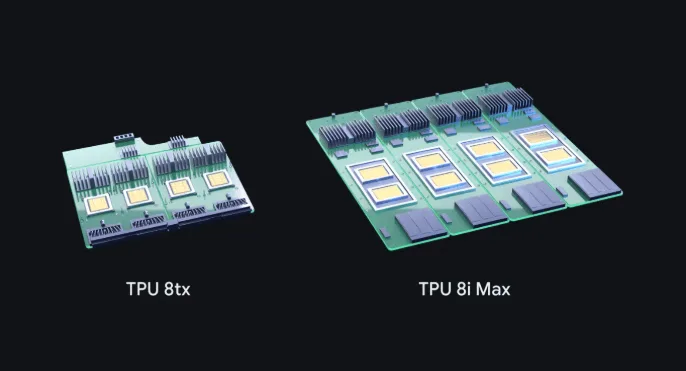
On 11 9, Google released two eighth-generation AI computing systems, TPU 8tx and TPU 8i Max, targeting confidential inference and ultra-long context processing respectively. Together with TPU 8t and TPU 8i launched in 2026 4, four eighth-generation TPU systems have now been released this year, all based on the existing chip architecture and forming specialized computing platforms by adjusting packaging, memory, networking, and security configurations.
02TPU 8tx: A Confidential Computing Platform for Inference
TPU 8tx uses the same chips as TPU 8t, paired with fifth-generation AMD EPYC processors, and integrates hardware-level confidential computing capabilities, keeping sensitive data and model weights isolated and protected during computation. Aimed at finance, government, and other regulated industries, it can perform private model fine-tuning, distillation, reinforcement learning, and secure inference on a single platform. Google has equipped it with a low-latency Boardfly network for real-time inference; published performance figures show inference latency reduced by up to 50% compared with TPU 8t, while essentially maintaining the original compute performance.
03TPU 8i Max: Dual-Chip Package for Long Context
TPU 8i Max integrates two TPU 8i chips into a single package, doubling compute capability, on-chip SRAM capacity, and HBM bandwidth relative to TPU 8i. It increases chip count while keeping the existing rack footprint, and is mainly intended for high-memory-demand tasks such as million-token context processing, large-scale code analysis, and long-video understanding.
04Software Toolchain and Resource Scheduling
Google has simultaneously expanded the TPU software toolchain: TorchTPU supports running PyTorch code and Hugging Face models directly on TPUs; the TPU agent toolset has entered preview and can integrate with development tools such as Claude Code, Cursor, and Google Antigravity. Agent Compute Engine automatically pauses idle sessions and moves working memory off the chips while agents wait on database queries, external tool calls, or human feedback; the open-source TPU Sync combines HBM, host memory, shared storage, and data center networking into a tiered storage system, with tests showing KV cache transfer latency and time-to-first-token reduced by more than 90%. Cloud Pathways is now generally available, supporting a single controller to coordinate multiple TPU compute partitions; GKE dynamic slicing is also generally available, dynamically combining or splitting TPU resources via optical circuit switching, with task startup speed up to 5 times faster and failure recovery speed up to 4.5 times faster.
Editorial Analysis Inferred from source information
Based on the source information, Google's eighth-generation TPU strategy keeps the chip architecture unchanged while covering different workloads through differentiated combinations of packaging, memory, networking, and security configurations: 8tx targets confidential computing scenarios in regulated industries, while 8i Max improves long-context throughput within a fixed rack footprint via a dual-chip package. The accompanying software stack (TorchTPU, the agent toolset, TPU Sync, Cloud Pathways, GKE dynamic slicing) focuses on lowering migration barriers and improving resource utilization for agent workloads. For enterprises, if sensitive-data compliant inference is involved, 8tx's hardware-level confidential computing and low-latency networking are clear selling points; if workloads center on long-context and long-video understanding, the doubled SRAM and HBM bandwidth of 8i Max are more relevant. All performance figures come from Google-published data; actual results need to be validated on one's own workloads.