

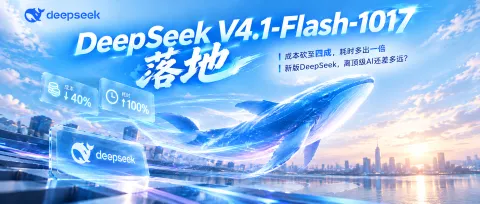
01Release Facts
On 2026 17, 10, DeepSeek upgraded V4.1-Flash in place to version 1017, with the web client, app, and API switched over simultaneously. The API model name remains deepseek-flash and pricing is unchanged. The same day, Search/Fetch API opened, billed per successful request at 5 yuan per 1000 requests. The underlying MoE architecture and parameter count are unchanged; the upgrade focuses on capability fine-tuning and agent-specific reinforcement learning optimization, and the weights remain under the MIT license.
02Benchmark Results
| Benchmark | Before upgrade | After upgrade | Notes | ||||||||||||
|---|---|---|---|---|---|---|---|---|---|---|---|---|---|---|---|
| DeepSWE v1.1 | 74.2 | 77.0 | Mini-SWE-V2, Pass@1,Terminal-Bench 4.0 | 31.2 | 42.3 | Claude Code harness,ProgramBench | 20.3 | 29.1 | ,NL2Repo-Bench | 65.4 | 68.2 | ,Automation-Bench v1.0.6 | 54.8 | 60.5 | Highest value among the six models in the official comparison table |
03Cost vs. Speed Trade-off
All 10 coding tasks passed for all three models across three runs each: DeepSeek at 0.045 USD and 2 min 38 sec; Claude Opus 5.5 at 0.1168 USD and 37 sec; GPT-6 Astra at roughly 0.26 USD and 55 sec. The cost gap stems from 97.9%'s input cache hit rate; DeepSeek averages 15.3 steps per task versus Opus at 3.7 steps. After lowering the reasoning tier, time was 1 min 31 sec and cost 0.0257 USD, but 3 of 30 runs failed.
04Methodology Limits and Open Gaps
Benchmarks are tied to specific evaluation frameworks and sampling strategies, so scores across frameworks cannot be directly compared; official optimization targeted DeepSeek Harness, Tencent CodeBuddy, and WorkBuddy. Three unresolved gaps: hallucination and long-chain correction, latency differences by context (acceptable for async, friction for interactive development), and low-price competition from GPT-6 Luna (0.0145 USD) and Haiku 5.5 (0.0208 USD).
Editorial Analysis Inferred from source information
The source presents a clear trade-off structure: this version trades time for cost, making it suitable for cost-sensitive, asynchronously executed batch Agent tasks, but not for interactive development where changes need immediate verification. 97.9%'s cache hits come from multi-turn session reuse, so the benefits shrink for short, single-shot calls — this defines the applicable premise of the cost advantage. Benchmark scores are highly tied to the harness and sampling methodology, so scores across frameworks cannot be directly compared; official results are optimized for their own Harness, shifting the competitive focus toward the coupling of models and toolchains. GPT-6 Luna and Haiku 5.5 have lower per-item costs, indicating that low pricing is no longer an exclusive label; subsequent competition will return to completion quality and long-chain reliability.