


01Release Facts
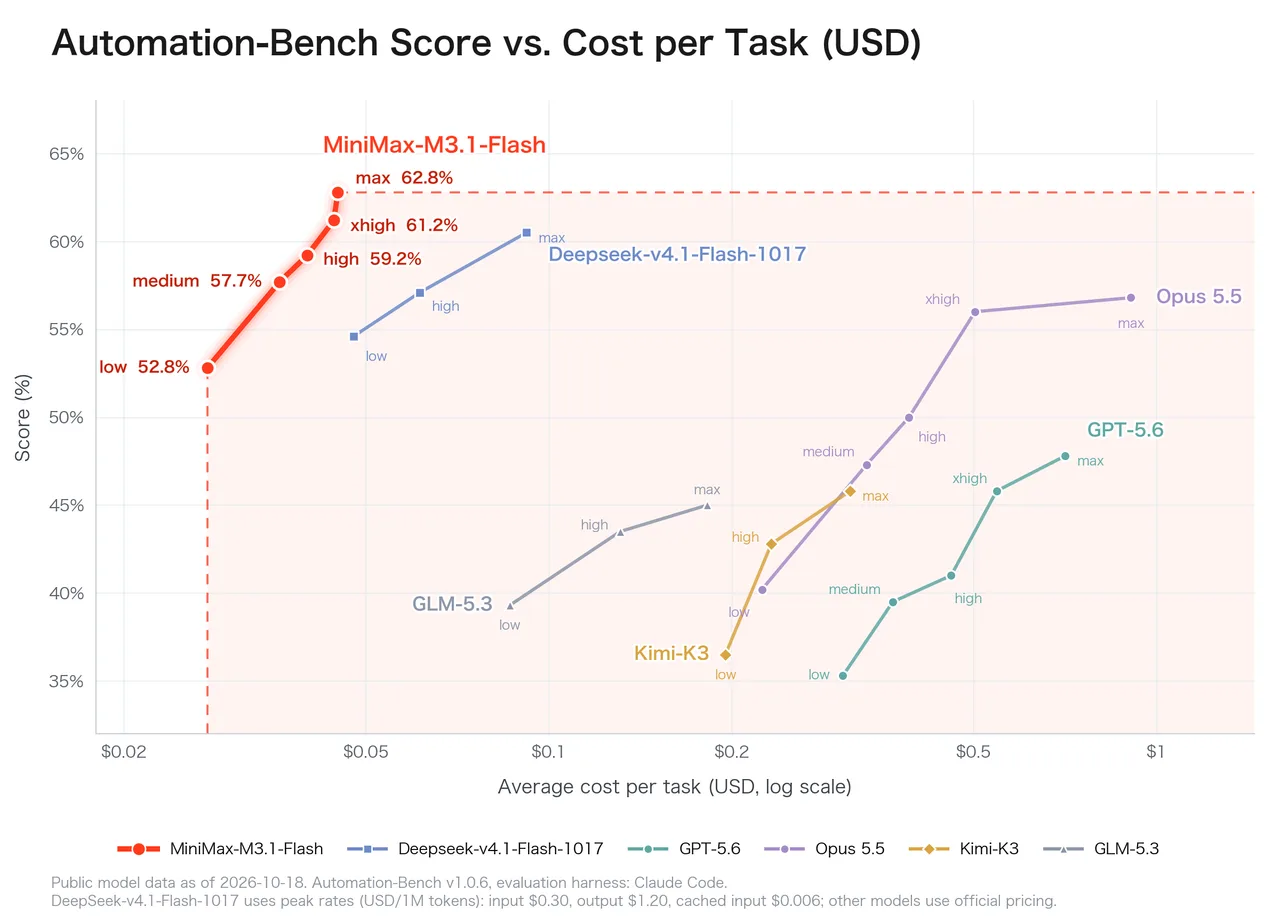
MiniMax officially released MiniMax M3.1 Flash on 10 19, 2026. According to official statements, Space Bunny, which previously ran anonymously, processed over 200 trillion tokens and was an earlier version of M3.1 Flash. Positioned as the next-generation Flash series, the model focuses on agentic tasks, coding, Computer Use, and cybersecurity capabilities. Officially claimed nearly 3x faster online inference speed and a 70% reduction in usage cost.
02Officially Published Benchmark Results
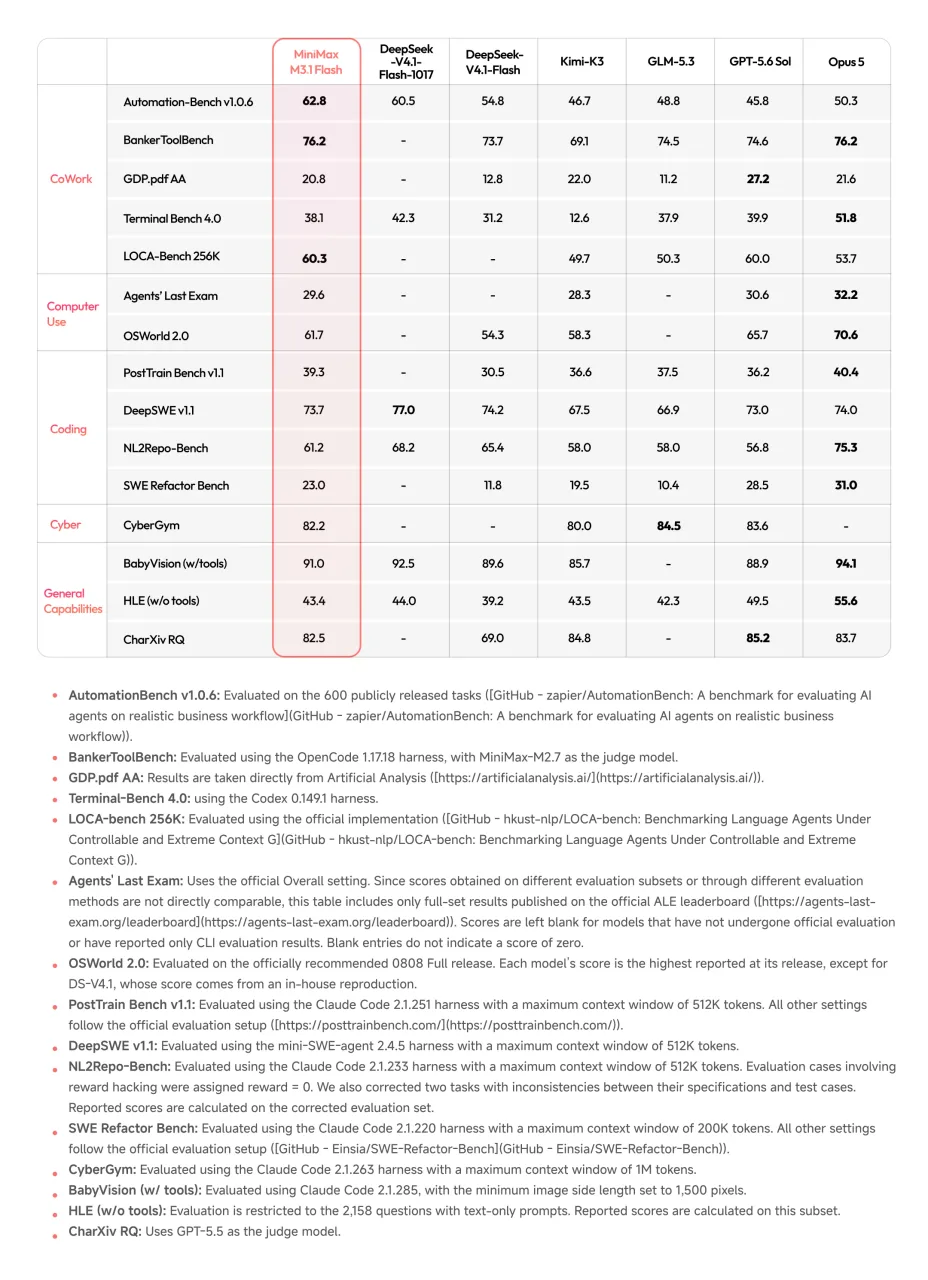
Official figures list multiple benchmarks: top-tier placement on AutomationBench-AA; BankerToolBench score of 76.2, testing multi-step planning, file consistency, financial compliance, and chained tool calling; DeepSWE v1.1 score of 73.7%, a benchmark requiring models to independently understand code, develop features, fix issues, and pass test validation; OSWorld V2 score of 61.7 and Agents' Last Exam (ALE) score of 29.6, both officially claimed to rank first among Chinese models; and CyberGym score of 82%.
03Inference Efficiency and Pricing
Officially claimed inference efficiency is improved through more aggressive sparsification, with typical output speed reaching 200+ TPS and median (P50) sustained at 170+ TPS. Overall usage cost for agentic tasks is down 70% versus the previous generation. Pricing is per million tokens: input $0.15, output $0.60, cached input $0.015.
04Availability and Roadmap
M3.1 Flash is now available via MiniMax API, M Plan, and MiniMax Code, with model weights to be released later. Officials also previewed a Pro version positioned for higher intelligence ceilings, but no timeline was given.
05Use Cases and Caveats
Based on the official capability description, the model suits enterprise workflow automation across SaaS systems (end-to-end sales, marketing, operations, customer service, finance, and HR processes), low-cost batch software engineering tasks, and security assistance such as code auditing, vulnerability patching, penetration testing, and malware analysis. Note: the results and use-case descriptions above all come from official announcements and are self-reported, without third-party independent evaluation; no specific timeline was given for either the Pro version or the open weights.
Editorial Analysis Inferred from source information
Based on official figures, M3.1 Flash is positioned to drive down the per-task cost of agent execution: on one hand, more aggressive sparsification optimizes inference efficiency (officially P50 output speed of 170+ TPS and peak of 200+ TPS); on the other, overall usage cost for agentic tasks is cut by 70% versus the previous generation, with simple tiered per-million-token pricing ($0.15/$0.60/$0.015 cached input). For enterprises running long tool-call chains across SaaS workflows in sales, customer service, or finance, and for dev teams doing large-scale code fixes and validation, this means batch tasks at a lower budget. Its benchmarks cover four directions—agent execution, software engineering, computer operation, and security—with the CyberGym 82% result pointing to vulnerability discovery and validation scenarios, where security teams could use it for code auditing and penetration testing assistance. Note: all figures are official self-reported data, and statements like 'reaching the level of leading models' lack itemized comparisons against specific competitor models; retesting against your own tasks before adoption is recommended.
- All results are officially published by MiniMax, without third-party verification
- The 'on par with leading models' comparison lacks itemized data against specific competitors
- Inference speed figures are based on official typical-usage metrics; performance under real loads remains to be verified
- Model weights have not yet been released; degree of openness awaits confirmation
Sources MiniMax Research;新浪财经(来源:网易智能)
Compilation Notes 内容由 AI 根据公开资料整理;事实与推断分开呈现。
Content Correction