Issues and Approaches
Challenges Faced
Modern manufacturing requires high-precision 3D scanning as a digital inspection tool. As technology advances and demands for production efficiency rise, demand for automated 3D inspection solutions keeps growing, while enterprises face constraints from different space limitations, varying workpiece characteristics, and requirements for domestically developed software.
Solutions and Approaches
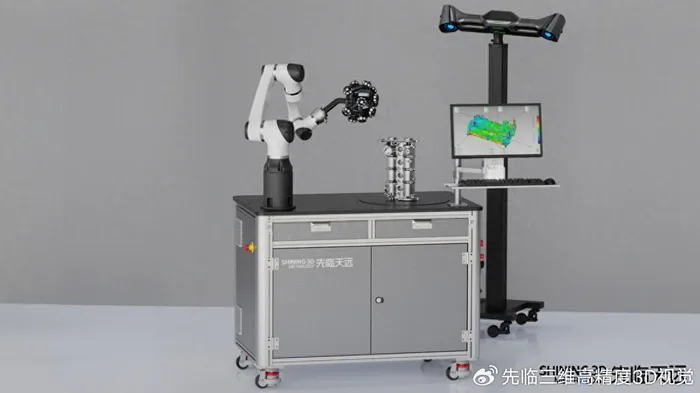
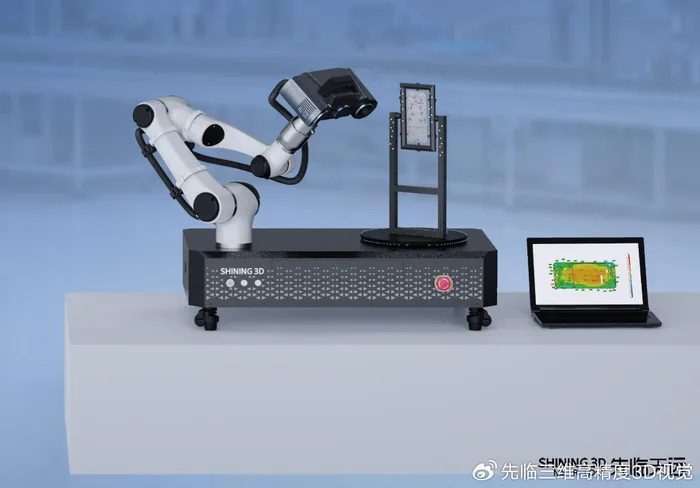
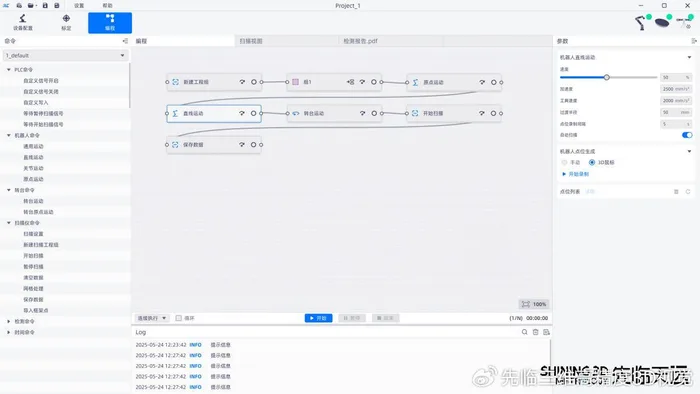
The Shining Tianyuan RobotScan automated intelligent 3D inspection system comes in two standardized product forms—floor-standing and desktop—and can flexibly pair with a stationary blue-light 3D scanner (metrology-grade accuracy, for precision manufacturing), a handheld laser 3D scanner (for the automotive industry and general machinery), or a tracker-based laser 3D scanner (no positioning targets needed, for rail transit and more). All three software components in the system—the 3D scanner software, the RobotScan Control automation control software, and the SHINING3D Inspect 3D inspection software—are independently developed by Shining 3D: RobotScan Control directly controls collaborative robot arms, servo turntables, and scanners, using cards to create process nodes and connect them to express logic relationships; SHINING3D Inspect is PTB certified and adapted to the Kylin domestic operating system. For large workpieces, custom non-standard solutions are available, with optional robot arms, servo gantries, AGVs, and other actuators; the robot arm, control software, and inspection software can also be selected from mainstream industry brands according to user needs.
System Composition
Perception
Metrology-grade accuracy and high resolution, suited to precision manufacturing fields such as electronics and electrical appliances, and civil aviation
High accuracy with stable repeatability, portable and efficient, suited to segment manufacturing such as the automotive industry and general machinery
No positioning targets required, high accuracy and efficiency, suited to the automotive industry, rail transit, energy and heavy industry, and more
Body and Platform
Directly controls collaborative robot arms, servo turntables, and scanners; card-style process nodes support standalone execution, breakpoint debugging, and parameter configuration
Floor-standing models can integrate loading/unloading systems for batch inspection; desktop models have a small footprint and can be placed in workshops or measurement rooms
For large workpieces, robot arms, servo gantries, AGVs, and more can be optionally configured to build customized automated 3D inspection solutions
Business
Dual-certified for measurement accuracy by PTB; performs 3D comparison and 3D measurement and outputs inspection reports; certified for Kylin OS compatibility
Editorial Analysis Inferred from source information
From a product portfolio perspective, the solution's differentiation lies in full-stack in-house software (scanning, control, and inspection software all self-developed) plus the PTB certification of the inspection software and domestic OS adaptation, making it well suited to quality inspection scenarios with localization and metrological traceability requirements. The two product forms reflect a trade-off between space and throughput—the floor-standing model targets batch full-size inspection on production lines, while the desktop model fits space-constrained workshops or measurement rooms. Open selection of robot arm and software brands lowers the integration barrier for users' existing production lines, but also means system integration outcomes depend on user choices.