Issues and Approaches
Challenges Faced
Low-volume high-mix production increases the burden of equipment investment; LCDs, semiconductors, and electronic components require high-precision inspection equipment. Manufacturing/inspection equipment manufacturers and models are difficult to standardize, resulting in low versatility and specialized operation and maintenance methods, which ultimately leads to growing equipment inventory and steadily rising equipment investment and inventory management costs.
Solutions and Approaches
Consolidate inspection equipment with highly versatile vision systems: the KEYENCE XG-X series and CV-X series provide area cameras, line scan cameras, and 3D cameras for selection according to inspection content (e.g., high-pixel area cameras for LCDs, line scan cameras for wide-format sheet surface inspection, and 3D cameras when height information is needed); robot vision supports programming languages from multiple robot manufacturers to adapt to mixed production lines; and mixed use of different vision systems is supported, covering multiple processes with 1 units of equipment, reducing equipment inventory and the man-hours required to learn new equipment.
System Composition
Sensing
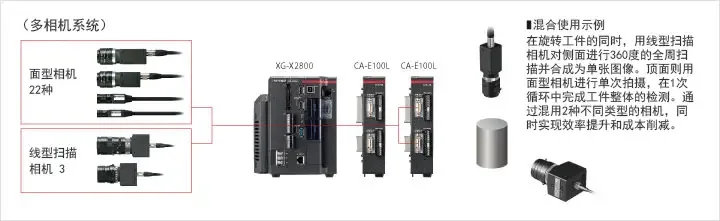
24 types (31 to 6400 megapixels), used for high-resolution detail inspection such as LCD products
Used for wide-format sheet surface inspection and 360-degree full-perimeter scanning of cylindrical workpiece sides
Used when grayscale information alone is insufficient for judgment and height detection is required
Platform & Hardware
Supports mixed use of up to 4 types of cameras, enabling both efficiency improvement and cost reduction
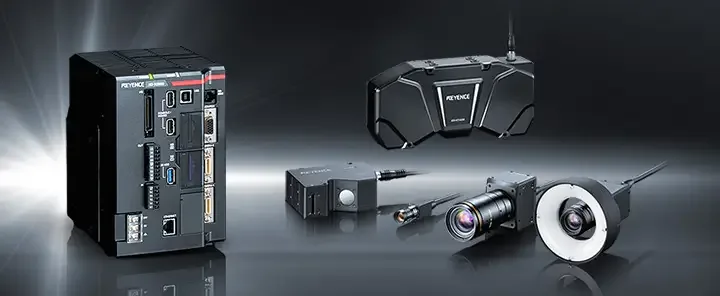
High-speed, high-capacity intelligent guidance vision system; together with the XG-X series, offers selectable camera types
Business
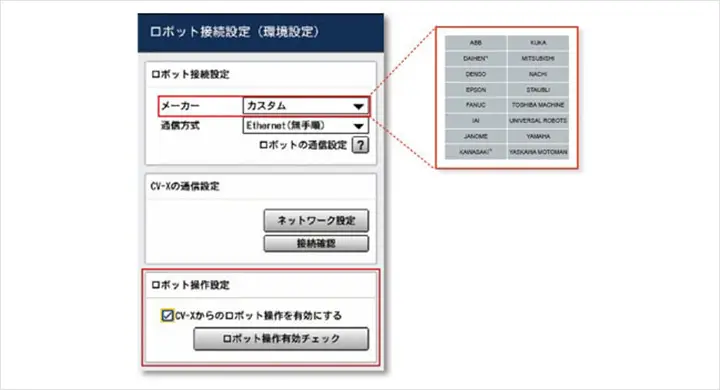
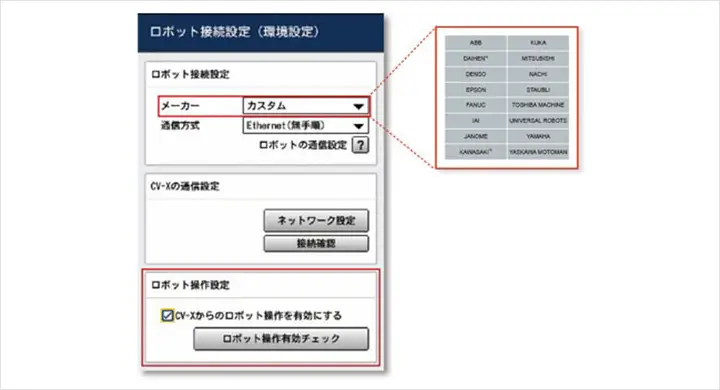
Supports programming languages of industrial robots from 17 domestic and international manufacturers, adapting to mixed production lines
Estimates cost reduction based on number of new units × unit price + number of inventory models × unit price + training costs
Implementation Checklist
- Confirm whether the industrial robot manufacturers used on the production line are within the 17 supported manufacturers
- Select camera types according to inspection content (high resolution, wide-format surface, height/3D)
- If multiple inspection types need to share 1 unit of equipment, confirm the combinations and limitations of XG-X series camera mixed use
- Use the formula provided by the source (number of new purchases × unit price + number of inventory models × unit price + training costs) to estimate your own gains
- Verify the comparison benchmarks and version conditions stated in the mixed use capability descriptions
Editorial Analysis Inferred from source information
This is a vendor-provided selection methodology and trial calculation explanation, serving as a reference solution rather than a delivered case: the core idea is to replace multi-vendor specialized inspection equipment with a platform-based vision system, compressing inventory and learning costs through unified selection criteria, camera mixing, and robot compatibility. It is suitable for production lines with many specialized inspection devices, miscellaneous inventory models, and dispersed maintenance; however, the 470 million yen reduction is only a trial calculation example based on source-defined parameters, and capabilities such as camera mixing are promoted based on comparison targets (CV-700), so verification against actual inspection requirements is needed.