

Issues and Approaches
Challenges Faced
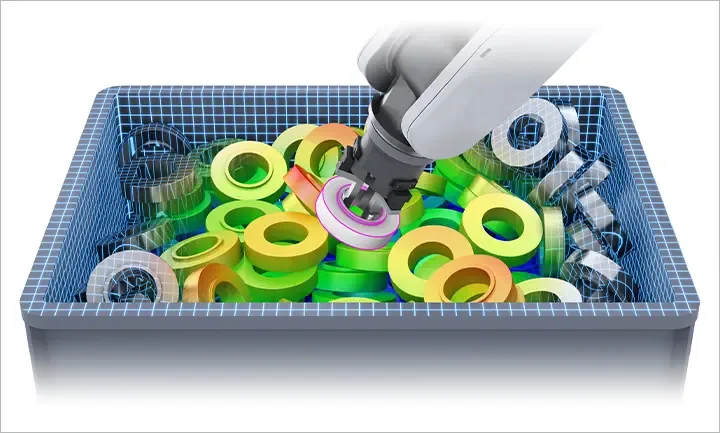
Bin picking operations require picking randomly piled workpieces from containers such as parts boxes. Conventional 2D vision solutions require feeding and alignment devices such as part feeders and jigs, which are time-consuming and labor-intensive; vertically stacked workpieces also require recognition of spatial information such as height, which exceeds the recognition capability of 2D systems. Production sites also face labor shortages, heavy manual workload, unstable speeds, and defects caused by human error.
Solutions and Approaches
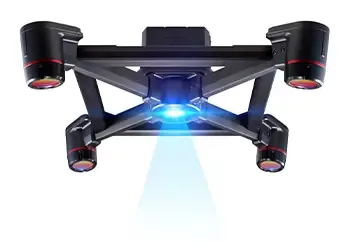
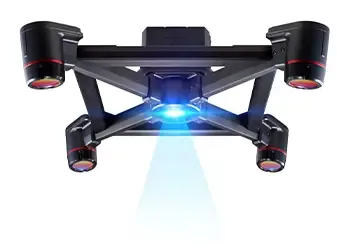
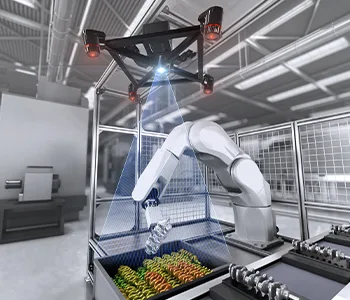
The solution uses an industrial robot as the execution body, paired with the KEYENCE 3D robot vision system CV-X480D as the sensing and image processing core. CV-X480D Using 4 cameras to capture images from different angles, it generates gapless 3D images. Equipped with a high-precision CMOS sensor, high-speed processor, and custom-designed projector, it recognizes the position, orientation, and height of workpieces, directly identifying randomly piled parts for random picking and eliminating the need for part feeders, jigs, and part alignment processes. The system includes a path generation tool that automatically calculates obstacle-avoidance trajectories considering interference from peripheral equipment and robot posture, as well as a picking simulator that reproduces piled conditions on a computer using a dedicated physics engine for simulation verification. An optional area camera expansion unit (choose up to 2 cameras from 20 types) is also available, enabling grip deviation compensation, part type recognition, and placement position deviation compensation, used in conjunction with the 3D vision system.
Implementation Checklist
- Confirm whether the target workpiece shape, material (reflective/matte/soft), and weight are within the applicable range of 3D recognition
- Assess whether part feeders or alignment processes still need to be retained on-site, and calculate the space saved by eliminating peripheral equipment
- After setting the layout of the robot, boxes, and obstacles, use the picking simulator to verify picking success rates on a computer
- Confirm whether the area camera expansion unit is needed for part type recognition and placement compensation
- In deep box scenarios, verify whether obstacle-avoidance trajectories and pull-out/lift strategies can handle workpieces near the sides and overlapping parts
Editorial Analysis Inferred from source information
In terms of solution applicability: First, hardware closed-loop — 4 camera imaging and projection patterns (directional-difference projection analysis at 90 degrees mitigates multiple reflections from metallic surfaces) are designed for typical challenges in bin environments such as reflective surfaces, piled parts, and deep boxes, enabling collision-free picking in deep boxes while avoiding contact with the box and other workpieces. Second, software lowers the entry barrier — path generation and picking simulation can be completed offline with mouse operations for teaching, requiring no prior specialized knowledge, reducing trial-and-error costs during introduction. Third, spatial and flexibility benefits — eliminating peripheral equipment such as part feeders, jigs, and hoppers makes it suitable for space-constrained and high-mix low-volume production lines, and product changeovers can be done simply by changing programs. Note that this is a reference solution from the manufacturer's product page; no specific customers, measurement metrics, or deployment conditions are provided.
- Source is a KEYENCE product introduction page with no third-party verification
- No actual deployment customers, production line scale, or ROI data provided
- Advantages (mitigating labor shortages, reducing labor costs, etc.) are general manufacturer claims without measured benchmarks
- Workpiece application videos are demonstration scenarios and do not represent actual delivery results
Compilation Notes 内容由 AI 根据公开资料整理;事实与推断分开呈现。
Content Correction