Issues and Approaches
Challenges Faced
Substations face issues such as fragmented systems, low video utilization efficiency, non-intuitive monitoring, inability to achieve full-time coverage, lack of safety supervision, and over-reliance on manpower; as the final link in delivering power to end users, the distribution network directly affects power supply quality, and a large number of distribution facilities operate unattended.
Solutions and Approaches
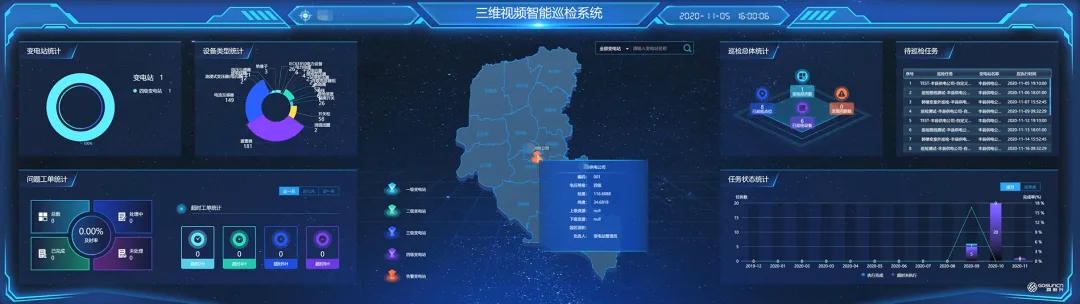
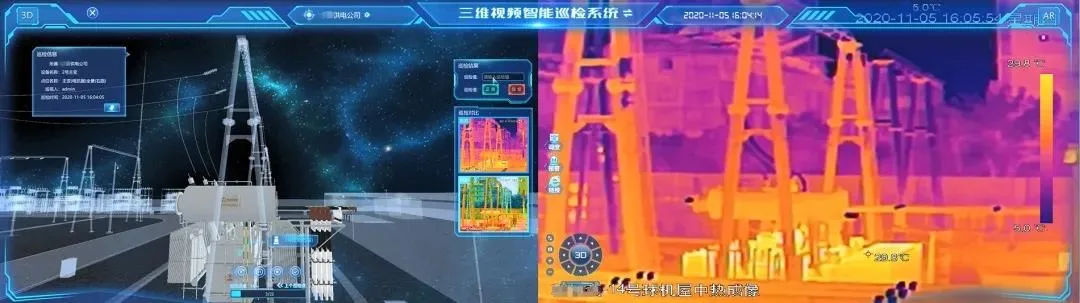
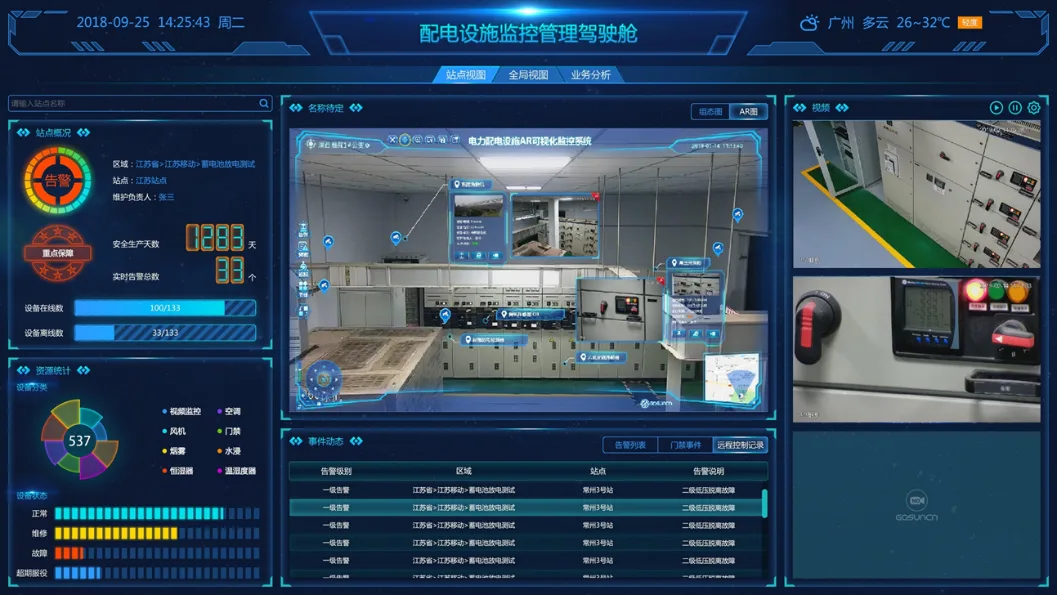
Gosunells proposed a solution approach of "strategy formulation—process monitoring—intelligent analysis—closed-loop resolution", leveraging cloud computing, big data, IoT, mobile internet, artificial intelligence, AR live map technology, and 3D visualization technology to launch a substation 3D video intelligent inspection solution: it builds a holographic visualization intelligent supervision platform using 3D+AR+AI technology, with AR high-point and indoor/outdoor low-point tagged video linkage enabling seamless picture-in-picture switching for high-low linked stereoscopic monitoring; existing conventional cameras are AR-enabled via AR gateways following a reuse-first principle, with support for 3D BIM integration and compatibility with OSGB, FBX, and OBJ model formats to reduce redundant modeling; AI analysis covers meter reading recognition, safety helmet detection, perimeter detection, open flame/smoking detection, and personnel behavior recognition such as work uniforms/safety harnesses/safety barriers. On the distribution side, an integrated smart power distribution facility monitoring system enables remote monitoring of distribution facilities through telesignal, telemetering, telecontrol, teleadjustment, and televideo technologies, with smart IoT gateways collecting data from sensors, smart devices, and video cameras and configuring linkage strategies (e.g., temperature/humidity linkage with air conditioners and dehumidifiers, SF6 threshold-triggered ventilation, and water-level-triggered pumps); inspection personnel can receive work orders, view on-site video, and navigate to the site via a mobile APP.
System Composition
Perception
Following a reuse-first principle, the AR gateway enables AR functionality for conventional substation cameras
Comprehensive data collection via smart IoT gateways, including temperature/humidity sensors and more
Body & Platform
Built on 3D+AR+AI technology, with AR high-point and low-point tagged video linkage and picture-in-picture switching; compatible with OSGB, FBX, and OBJ 3D BIM models
Collects data and supports configuration of multiple intelligent linkage strategies, e.g., temperature/humidity linkage with air conditioning and dehumidifiers, SF6 threshold-triggered ventilation, and water-level-triggered pumps
Business
Meter reading recognition, safety helmet detection, perimeter detection, open flame/smoking detection, and personnel behavior recognition such as work uniforms/safety harnesses/safety barriers
Enables remote monitoring of unattended distribution facilities via telesignal, telemetering, telecontrol, teleadjustment, and televideo, covering environmental data, access control, video, security, partial discharge detection, equipment temperature measurement, and more
Receive alarm work orders, open on-site alarm video to view the scene, and navigate to the site
Implementation Checklist
- Verify the models and quantities of existing cameras at the site, and assess the feasibility of AR gateway retrofit with camera reuse (the source explicitly follows a reuse-first principle).
- Confirm whether the 3D BIM model format falls within the OSGB, FBX, and OBJ compatibility range to avoid redundant modeling.
- Inventory front-end sensors and linkage equipment on the distribution side (air conditioners, dehumidifiers, ventilation equipment, water pumps) and their integration and linkage strategy requirements.
- Confirm the monitoring scope of environmental data, access control, partial discharge, and temperature measurement for unattended distribution facilities.
- Plan the mobile APP inspection workflow for alarm work orders, video access, and navigation.
- The source provides no delivery cases or measured results; verify implementation data with the solution provider before procurement.
Editorial Analysis Inferred from source information
The two solutions target different stages of power operations and maintenance: the substation solution focuses on inspection automation and intelligent safety supervision, reducing retrofit costs through AR-enabled camera reuse and 3D BIM compatibility, making it suitable for existing sites with many conventional cameras that wish to avoid redundant modeling; the distribution solution focuses on remote monitoring and linked response for unattended facilities, relying on smart IoT gateways to connect front-end sensors and video equipment, and using a mobile APP to close the loop from alarm to repair. Both are built on video and sensor data collection, belonging to the perception and platform layers of the power industry.