


01Events and Facts
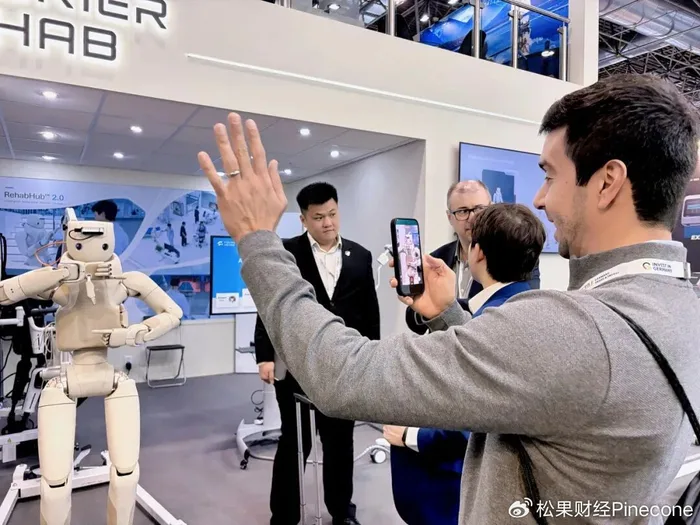
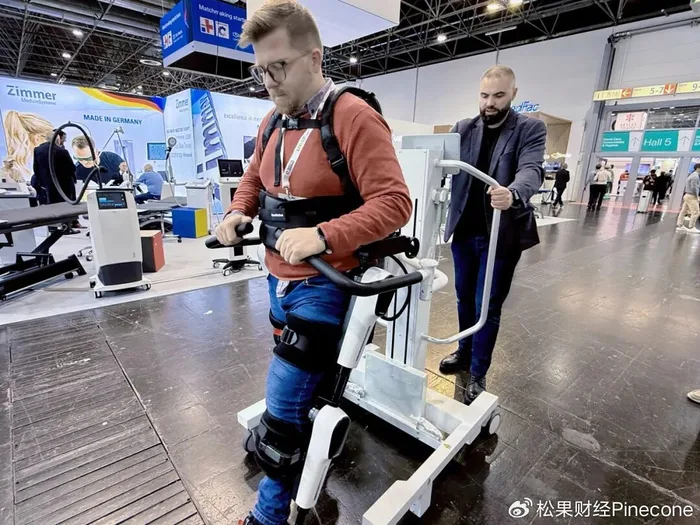
From 16 to 19 in 11, MEDICA 2026 was held at Messe Düsseldorf in Germany. Fourier exhibited its third-generation GRx series humanoid robot GR-3 along with its Smart Rehabilitation Port solutions, targeting two scenarios: senior-care companionship and professional rehabilitation.
02Key Technical Points of GR-3
GR-3 achieves coordinated feedback of speech output, body movements, and emotional expression by integrating large model task reasoning with its motion control system; in tic-tac-toe interactions, it perceives the board state through visual recognition and makes decisions with a logical deduction algorithm. The hardware uses a soft-cladding material process, integrating full-body motion control, multimodal perception, and natural interaction capabilities, making it Fourier's first Care-bot humanoid robot.
03Scenarios and Deployment
For public service scenarios, GR-3 can be equipped with an elderly-care vertical large model to provide policy consultation, health education, and interactive companionship; Fourier is also exploring rehabilitation training applications with university research teams and plans to expand into care tasks such as fixed-point patrols, material delivery, and rehabilitation guidance as lower-limb mobility is developed in the future. The Smart Rehabilitation Port covers the ExoMotus™ M4 lower-limb exoskeleton, ArmMotus™ EMU and M2 Pro upper-limb rehabilitation robots, and the OTParvos™ Pro digital OT assessment and training system, covering rehabilitation treatment types such as neurological, orthopedic, and pain rehabilitation.
04Scale Data
Fourier has provided products and services to 2000 hospitals and institutions across 40 countries and regions worldwide; the Smart Rehabilitation Port has been deployed in 300 rehabilitation departments nationwide, with a cumulative service population exceeding one million.
Editorial Analysis Inferred from source information
From a product strategy perspective, GR-3 integrates large model task reasoning with motion control and multimodal perception in a soft-cladded form, indicating that Fourier's differentiation for humanoid robots lies in senior-care companionship rather than industrial work; the tic-tac-toe demonstration is essentially a showcase of visual perception + logical deduction + multimodal feedback capabilities. The Rehabilitation Port enters the B2B institutional market with a mature rehabilitation equipment matrix plus a digital platform, forming a 'mature business + exploratory business' portfolio alongside GR-3. For readers, evaluating such care robots requires distinguishing deployed capabilities (the rehabilitation equipment matrix) from planned ones (lower-limb mobility, fixed-point patrols, etc.)—the latter currently being only directional statements.