

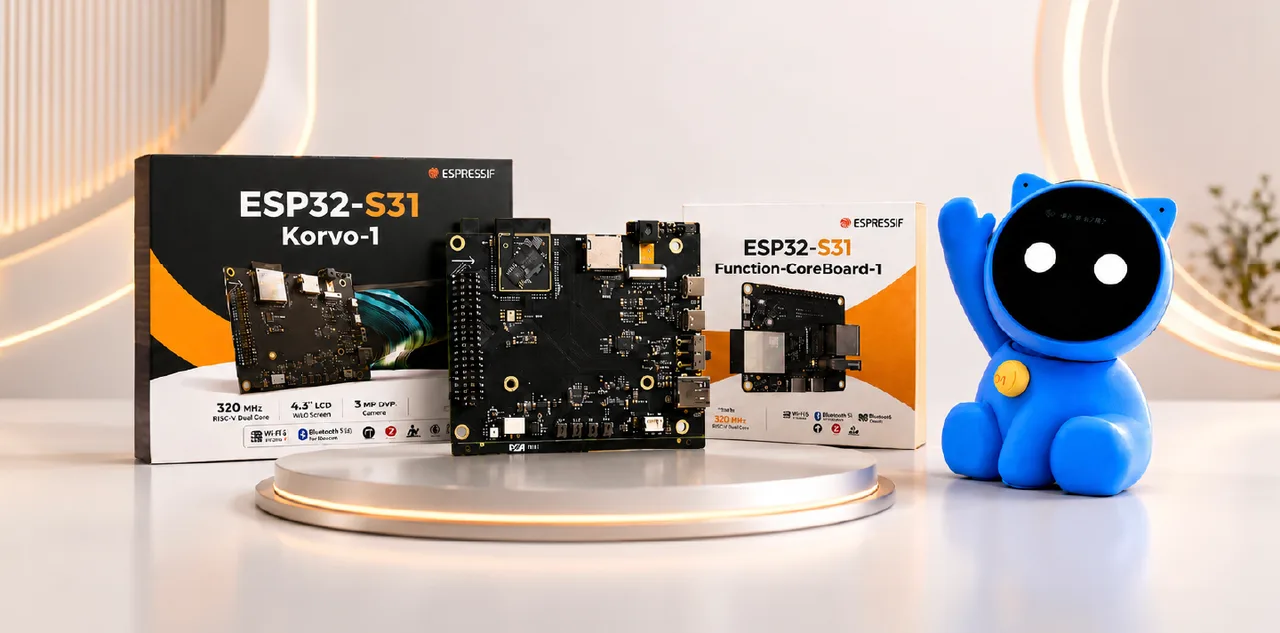
Specification Parameters
Processor
- Clock Frequency
- 320MHz · Increased from 240MHz to 320MHz, with architecture switched to RISC-V
- CoreMark Performance
- 相比 S3 提升约 65% · Overall performance benchmark metric
- AI Acceleration
- AI 指令集加速 · On-device inference, yolo11n local inference speed significantly improved
Interfaces & System
- GPIO Count
- 60 个 · Expanded available GPIO; 7 additional IOs freed up when adding a DVP camera
- Video Capture
- DVP 摄像头 + 硬件 JPEG 编解码 · Hardware JPEG encoding compression, combined with Wi-Fi 6 low-latency streaming
- Bluetooth Audio
- BLE Audio 及经典蓝牙 · Supports LE Audio broadcast multi-device synchronized reception and transmit nodes
- Wi-Fi
- Wi-Fi 6 · Native support
Memory
- PSRAM Interface Bandwidth
- 250 MHz · Upgraded from 80 MHz on ESP32-S3
Power
资料下载
Comparison with Similar Products
| Specifications | 本品 · ESP32-S31 | Hailo-8L | Hailo-8 Century High Performance PCIe Card | UFS-128I | MEM-L16 |
|---|---|---|---|---|---|
| Main controller | RISC-V | — | — | — | — |
| NPU | — | 13 TOPS | 208 TOPS | — | — |
| Memory / VRAM | — | — | — | — | 16 GB |
| Reference unit price | Request a Quote | Request a Quote | Request a Quote | ¥188 | ¥318 |
| Inventory | — | — | — | 11200 | 9600 |
Product introduction
In terms of performance, ESP32-S31 runs at 320MHz on the RISC-V architecture, with a CoreMark score approximately 65% higher than ESP32-S3. The higher clock speed makes traditional vision algorithms such as OpenCV color recognition respond faster. For connectivity and audio, the chip fully supports BLE Audio and Classic Bluetooth protocols, can connect directly to standard Bluetooth speakers for playback, supports multi-device synchronized reception of LE Audio broadcast with independent decoding of left and right channels, and can also serve as a broadcast transmitter node for multi-node audio synchronization. For image capture, GPIOs have been expanded to 60, leaving 7 usable IOs even when a DVP camera is connected; the built-in hardware JPEG codec combined with Wi-Fi 6 enables low-latency video streaming. For edge AI, the chip integrates AI instruction set acceleration, and the PSRAM interface bandwidth increases from 80 MHz to 250 MHz, significantly improving the speed of local yolo11n inference. For display, it supports RGB888 color depth and screen refresh resolutions up to 720P, and comes with a Pixel Processing Accelerator (PPA) and 2D-DMA, so rotation, scaling, mirroring, and color format conversion can be hardware-accelerated. Selection tip: when upgrading from ESP32-S3, pay attention to the differences in IO count, audio protocols, and graphics acceleration; before purchasing, verify the specific package, memory configuration, and development documentation, as the source page does not provide this information.